2010-03-05
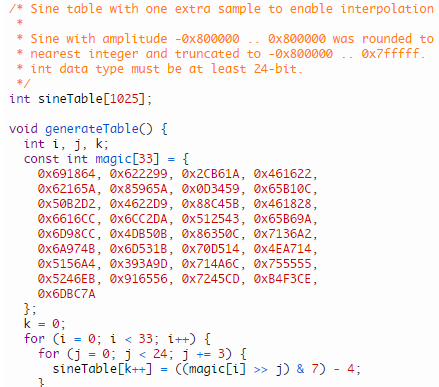
Here is a method for generating a sine look-up table in case you have little (a few kilobytes of) program memory. The idea goes like this: Let's say you have a sine wave lookup table of length 1024 with a 24-bit amplitude range. If you take the difference between successive samples, the range of the numbers is reduced. If you repeat the process a total of 3 times, the data will be dominated by the 3rd differential of the quantization noise and will have a range of -4 to 3, which can be conveniently stored in 3 bits only. This program below does the reverse, it generates the sine table from the 3-bit values, and also takes advantage of the symmetry properties of sine. So, instead of wasting 1024 program memory words for storing the original sine table, in the c-language implementation below, the compressed data takes only 35 24-bit words and the decompression code hopefully not too much more.
|
1 2 3 4 5 6 7 8 9 10 11 12 13 14 15 16 17 18 19 20 21 22 23 24 25 26 27 28 29 30 31 32 33 34 35 36 37 38 39 40 41 42 43 44 45 46 47 48 49 50 51 52 53 54 55 56 57 58 59 60 |
/* Multiplierless 1024-sample, 24-bit sine table generator * * by Olli Niemitalo in 2010-03-07. * This work is placed in the public domain. */ #include <stdio.h>; /* Sine table with one extra sample to enable interpolation * * Sine with amplitude -0x800000 .. 0x800000 was rounded to * nearest integer and truncated to -0x800000 .. 0x7fffff. * int data type must be at least 24-bit. */ int sineTable[1025]; void generateTable() { int i, j, k; const int magic[33] = { 0x691864, 0x622299, 0x2CB61A, 0x461622, 0x62165A, 0x85965A, 0x0D3459, 0x65B10C, 0x50B2D2, 0x4622D9, 0x88C45B, 0x461828, 0x6616CC, 0x6CC2DA, 0x512543, 0x65B69A, 0x6D98CC, 0x4DB50B, 0x86350C, 0x7136A2, 0x6A974B, 0x6D531B, 0x70D514, 0x4EA714, 0x5156A4, 0x393A9D, 0x714A6C, 0x755555, 0x5246EB, 0x916556, 0x7245CD, 0xB4F3CE, 0x6DBC7A }; k = 0; for (i = 0; i < 33; i++) { for (j = 0; j < 24; j += 3) { sineTable[k++] = ((magic[i] >> j) & 7) - 4; } } sineTable[1] = 51472; for (i = 3; i > 0; i--) { for (j = i; j <= 256; j++) { k = sineTable[j - 1]; sineTable[j] = k + sineTable[j]; sineTable[513-j] = k; sineTable[511+j] = -k; sineTable[1025-j] = -k; } } sineTable[768] = -0x800000; } int main() { int i; generateTable(); /* Printout */ for (i = 0; i < 1025; i++) { printf("%d\t%d\n", i, sineTable[i]); } return 0; } |
Here is a spreadsheet that illustrates the algorithm: sinetable.xls. The above implementation additionally embeds the seeds 0 and -3 in the magic data